What Is a Mining Pre-Feasibility Study (PFS)?

This is a preliminary analysis of a mining project that evaluates its technical and economic viability. It provides essential information to support decision-making regarding costs, mine design, and key challenges. Conducted after the mineral resource assessment, it helps determine whether the project justifies additional investment and reduces risks before committing to major expenses such as permitting or site development.

CORPORATE PRESENTATION

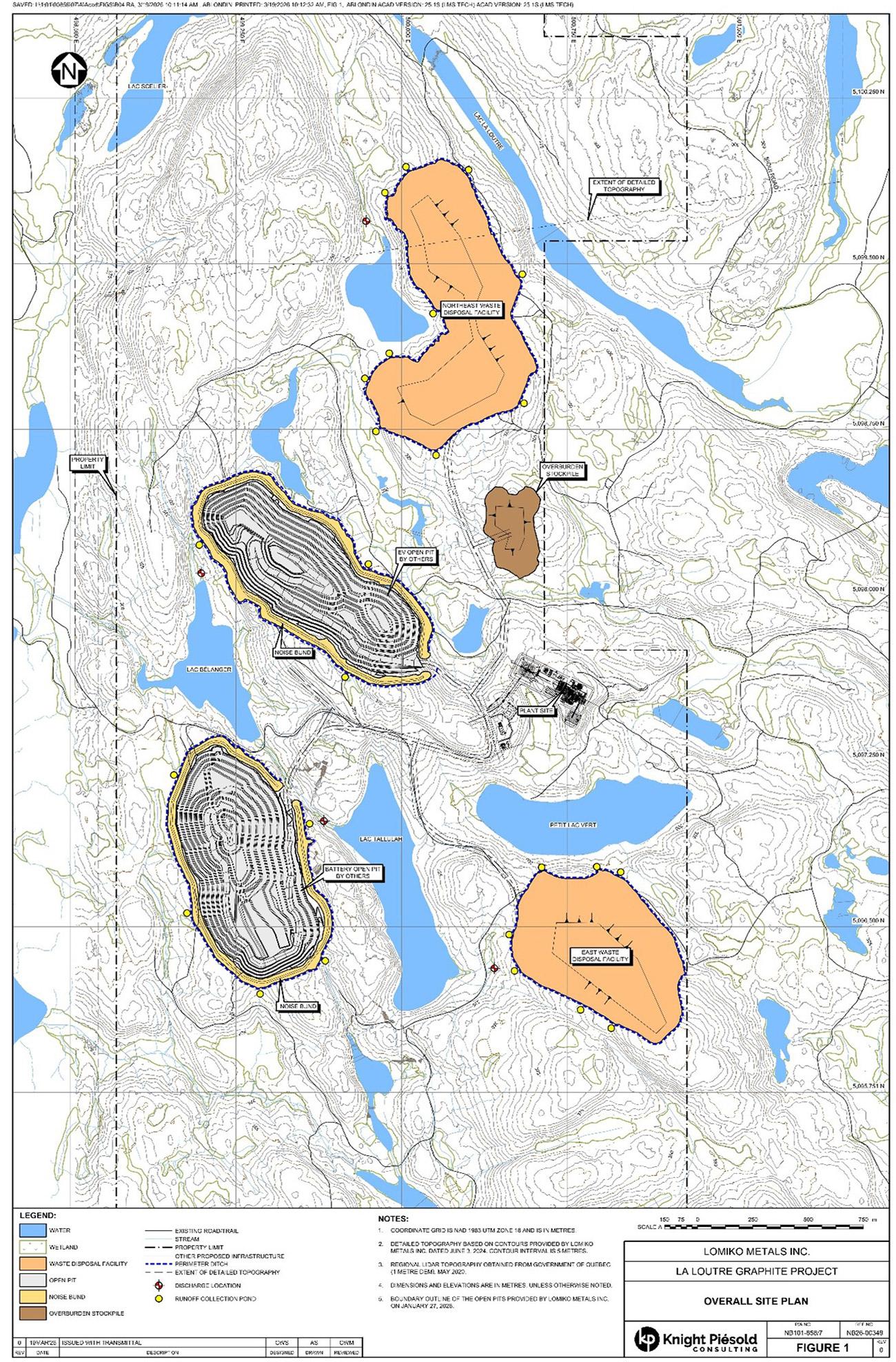
Site map:

La Loutre Graphite Project

Preview

The La Loutre project is located in the Nominingue-Chénéville deformation zone in south-central Quebec. The property consists of a large contiguous block of 42 mining claims totaling 4,528 hectares (45.3 km²) and is located approximately ~200km northwest of Montreal, in southern Quebec, 230 km southwest of the Nouveau Monde Matawinie project and 100 km southeast of the Imerys Lac-des-Îles graphite and carbon mine.

The study was conducted with the support of:

DRA

DRA Global

Coordinated the work in accordance with Regulation 43-101 and designed the surface infrastructure and the treatment plant

Norda Stelo

Norda Stelo

This includes geological studies, resource and reserve assessment, open-pit mine design, as well as environmental and water management aspects.

Knight Piésold

Knight Piésold

Contributed to the geotechnical design, including tailings management facilities, slope stability, and water management.

Metpro Management

Metpro Management

Interpreted the metallurgical tests

Mineral Resources

Resources indicated

0
kt
of ore
0
kt
of graphite
0
%
average graphite content

Measured resources

0
kt
of ore
0
kt
of graphite
0
%
average graphite content

Inferred resources

0
kt
of ore
0
kt
of graphite
0
%
average graphite content

These resources are estimated with a cut-off grade of 0.95% graphite, i.e. the minimum concentration allowing for economical exploitation in the scenario studied

Mining

0
years
is the lifespan of the mine
0
M
tons of ore will be processed at the plant
0
M
tons of graphite concentrate contains ~97% Cg
0
tonnes of graphite concentrate/year for the first 20 years
0
tonnes/year on average over 21 to 28 years
0
%
recovery

Financial analysis

Net present value (NPV)

  • Before tax: $797.5 million
  • After tax: $617.4 million

Internal rate of return (IRR)

  • Before tax: 30.3%
  • After tax: 24.7%

Investment recovery possible

  • Before tax: 3.1 years
  • After tax: 3.2 years

Initial investment required to build the mine and infrastructure (CAPEX): $504.5 million

These estimates are based on an average graphite price of US$1,524 per tonne and an exchange rate of CAD$1.42 = US$1.00

Crushing and processing

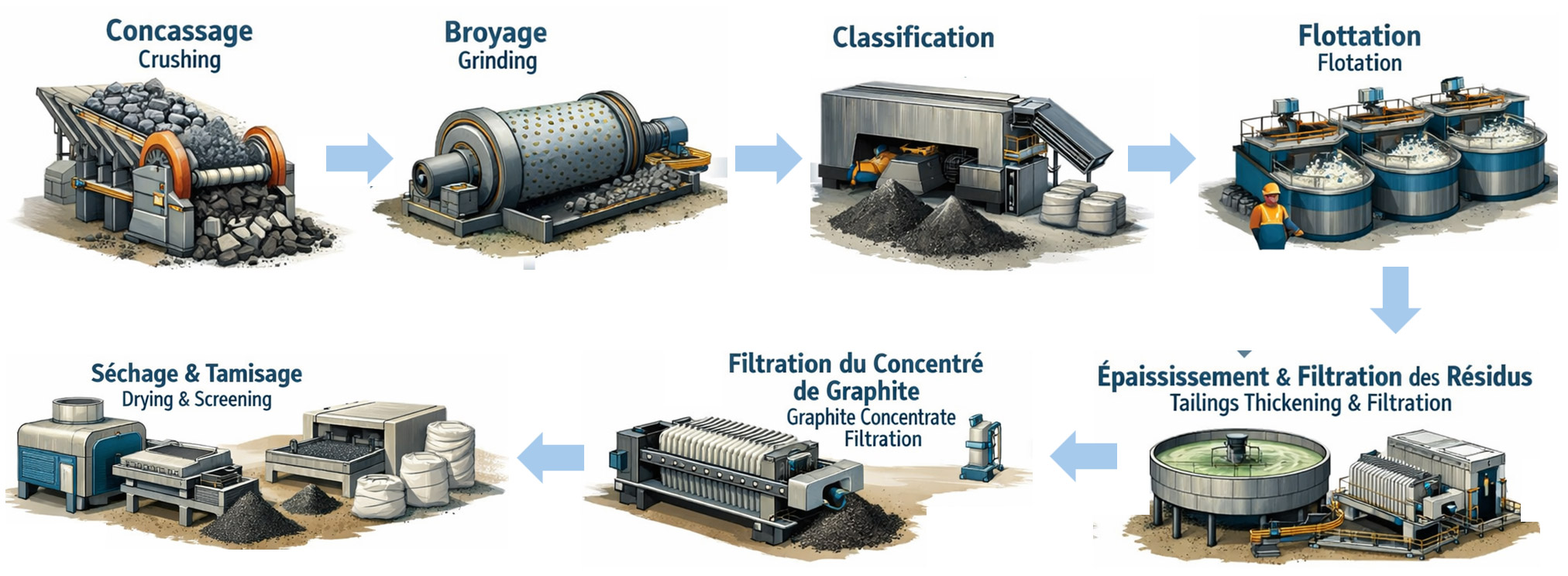
The La Loutre project’s processing plant will use a conventional flotation process to produce high-quality graphite concentrates. The processing circuit will include the following main steps:

crushing processing

0
M
Tonnes of ore/year
0
t/d
Average flow rate
0
t/h
Processing speed
0
hours
Annual operation

Water and waste management

Water

The project incorporates a water management approach aimed at minimizing disturbances to natural environments and maximizing water recirculation within the process. Mining infrastructure has been designed to avoid permanent watercourses, thereby reducing the need for water diversions.

The mining tailings will be filtered to reduce their moisture content, allowing for the recovery and reuse of water within the treatment process. The water used will come primarily from internal recycling and runoff, with freshwater input limited to the necessary amount.

The contact waters will be collected, directed to sedimentation basins, then treated before being discharged or reused in operations.

Mining waste

The management of tailings and waste rock will be progressively integrated throughout the mine’s life. At the start of operations, they will be temporarily stored on the surface in dedicated facilities, then reused for backfilling openpit mines at the end of operations.

Engineering measures, including the use of tailings to form protective dikes, the installation of drainage systems, and the collection of seepage water, will make it possible to:

  • control erosion
  • limit dust generation
  • to ensure safe water management.

Next steps

Qualified individuals believe that the results of the pre-feasibility study are sufficiently reliable and recommend that the La Loutre project be advanced to the next stage of its development.

Accomplishments

Technical and economic evaluation

Declared mineral reserves

Metallurgical testing

Environmental baseline studies

Fieldwork

Comparative studies

Next Steps

Launch of feasibility study

Continue geological exploration

Environmental impact assessment